
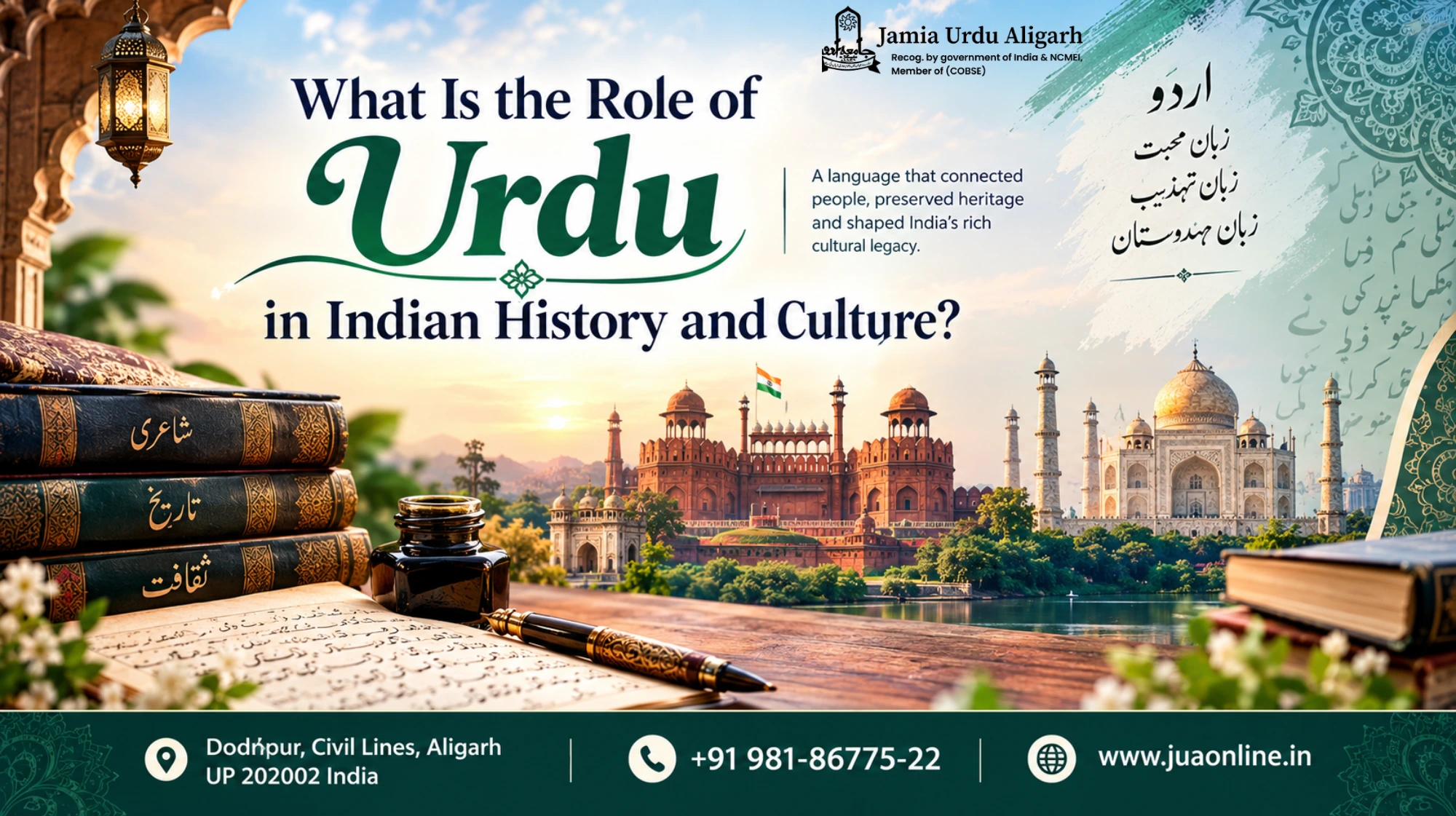
Urdu has played an important role in shaping Indian history and culture through its rich literary traditions, poetry, storytelling, and contribution to the freedom movement. Famous Urdu poets and writers have enriched Indian literature and promoted cultural understanding. The language has also influenced music, cinema, education, and everyday communication. Today, Urdu remains an important part of India's cultural heritage, connecting generations through its beautiful expressions, historical significance, and literary contributions to the country's diversity.
Quick Answer
What is the role of Urdu in Indian history and culture?
Urdu is an Indian-born language that began around 800 years ago in the Delhi region. It grew from the mix of local Indian speech with Persian, Arabic and Turkic words. Urdu shaped Indian poetry, music, cinema, journalism, food culture and good manners (called tehzeeb). It also gave India powerful freedom-movement slogans, such as "Inquilab Zindabad". Today, Urdu is one of the 22 scheduled languages in India's Constitution and is spoken by about 5 crore (50 million) people as a mother tongue, according to Census 2011.
Short Answers
- Q: What is Urdu language? Urdu is an Indo-Aryan language born in India, written in the Nastaliq script and known for its poetry and polite style.
- Q: Is Urdu an Indian language? Yes. Urdu began in India, and it is one of the 22 scheduled languages of the Indian Constitution.
- Q: Who is the father of Urdu poetry? Wali Deccani is often called the father of Urdu poetry, while Amir Khusro is seen as an early pioneer of the language.
- Q: Why is Urdu important in India? Urdu is important because it shaped Indian poetry, freedom slogans, cinema, journalism and shared culture.
- Q: Who wrote Saare Jahan Se Achha? Allama Iqbal wrote it in 1904
Table of Contents
- What Is Urdu? A Simple Introduction
- Where Did Urdu Come From? The Birth of the Language
- Urdu in the Delhi Sultanate and Mughal Era
- The Golden Age of Urdu Poetry
- Urdu and the British Period
- Urdu and India's Freedom Movement
- Urdu Literature After Independence
- Urdu in Indian Culture: Food, Dress, Manners and Festivals
- Urdu in Bollywood, Music and Qawwali
- Urdu Journalism and Media
- Urdu and Hindi: Same Roots, Different Scripts
- Is Urdu Only a Muslim Language? Busting the Myth
- Where Is Urdu Spoken in India? Official Status and Numbers
- Famous Urdu Institutions in India
- Challenges Facing Urdu in 2026-27
- The Future of Urdu: Digital, AI and Career Opportunities
- Quick Facts Table
- 10 FAQs About Urdu in India
- Conclusion
What Is Urdu? A Simple Introduction
Urdu is a beautiful, soft and expressive language. It is written from right to left in a style called Nastaliq, which looks like flowing art. When people hear Urdu, they often think of poetry, ghazals and deep emotions. But Urdu is much more than that.
Urdu is:
- A language born on Indian soil
- A bridge between many cultures
- A key part of India's Ganga-Jamuni tehzeeb (the shared culture of Hindus and Muslims)
- One of the 22 languages listed in the Eighth Schedule of the Indian Constitution
Many words you use every day, such as zindagi (life), dil (heart), dost (friend), kitaab (book), shukriya (thank you) and intezaar (wait), come from Urdu traditions. Even if you never studied Urdu, you speak a bit of it every day.
Where Did Urdu Come From? The Birth of the Language
The history of the Urdu language in India starts around the 12th and 13th centuries, in and around Delhi.
When Turkic and Persian-speaking soldiers, traders, poets and Sufi saints came to North India, they met local people who spoke Khari Boli and other regional languages. They needed to talk to each other in markets, army camps and Sufi gatherings. Slowly, a new common language was formed.
Key points about its birth:
- The word "Urdu" comes from a Turkic word ordu, which means "army camp". The language grew in busy camps and cities where many people met.
- Old names of Urdu: Hindavi, Hindi, Dehlavi, Rekhta, and Zaban-e-Urdu-e-Mualla (the language of the exalted camp or court).
- Amir Khusro (1253-1325), the great poet and musician of Delhi, wrote verses in Hindavi mixing Persian and local words. He is often called one of the earliest voices of this new language. Riddles, songs and couplets attributed to him are still loved today.
- Sufi saints like Baba Farid and Nizamuddin Auliya spoke simple, local language to reach common people. This helped Urdu spread across towns.
Important: Urdu is NOT a foreign language. It was born in India, grew in India and was nurtured by Indians of every religion. This is the most important fact in the story of Urdu.
Urdu in the Delhi Sultanate and Mughal Era
During the Delhi Sultanate and the Mughal Empire, Persian was the official language of the court. But common people in the streets spoke an early form of Urdu. Over time, it became the language of daily life, trade, music and poetry.
Urdu Reaches the South: The Deccan
Urdu also grew strongly in the Deccan (South India). Poets in places like Golconda, Bijapur and Aurangabad wrote in a form called Dakhni (Deccani Urdu). The poet Wali Deccani (1667-1707) is a famous name. When his poetry reached Delhi around 1700, it inspired Delhi's poets to write in Urdu instead of only Persian. This was a big turning point.
Urdu Takes Over Delhi's Poetry
By the 1700s, as the Mughal court became weaker, Urdu became the main language of poetry in Delhi and later in Lucknow. By the 19th century, it was the cultural language of the educated class across North India.
The Golden Age of Urdu Poetry
The 18th and 19th centuries are called the golden age of Urdu poetry. Delhi and Lucknow became centers of mushairas (poetry gatherings), where poets recited their verses in front of large audiences.
Great Poets of This Era
Poet | Known For |
|---|---|
Mir Taqi Mir (1723-1810) | Called "Khuda-e-Sukhan" (God of Poetry). Deep sadness and love in ghazals |
Mirza Sauda | Powerful satire and praise poems (qasidas) |
Mirza Ghalib (1797-1869) | India's most loved Urdu poet. Philosophy, wit and pain in simple words |
Zauq | Teacher of the last Mughal emperor, master of language |
Momin Khan Momin | Romantic ghazals |
Mir Anis and Mirza Dabeer | Masters of marsiya (poems of grief and sacrifice) |
Bahadur Shah Zafar | The last Mughal emperor, also a gifted poet |
Why Ghalib still matters in 2026: Ghalib's couplets are quoted in Parliament speeches, films, Instagram reels and school books. His letters, written in easy Urdu, also changed how Urdu prose was written.
Read More - Studying at Jamia Urdu Aligarh from Abroad: A Guide for Overseas Students
Urdu Poetry Forms You Should Know
- Ghazal: A poem of separate couplets, each with its own meaning, usually about love, loss and life
- Nazm: A poem on one theme from start to finish
- Rubai: A four-line poem
- Marsiya: A poem of mourning
- Masnavi: A long story told in rhyming couplets
- Qita: A short poem of connected lines
Urdu and the British Period
The British rule brought big changes for Urdu.
- Fort William College (Calcutta, 1800) was set up to teach Indian languages to British officers. John Gilchrist and others worked on Urdu textbooks. This helped Urdu prose and printing.
- Printing presses spread Urdu books and newspapers. Munshi Naval Kishore's press in Lucknow printed thousands of Urdu, Persian and Arabic books and became famous across Asia.
- Delhi College and Aligarh Movement: Scholars like Sir Syed Ahmad Khan used Urdu to bring modern education and science to Indian readers. The Aligarh Muslim University grew out of this effort.
- Persian was replaced: In 1837, the British removed Persian from courts and offices. In North India, Urdu in the Persian script became widely used in courts and government work.
- The Hindi-Urdu debate: Later in the 1800s, arguments began about script and identity. Urdu (Persian script) and Hindi (Devanagari script) started to be seen as rivals by some people, even though everyday spoken language was nearly the same. This divide was partly a result of colonial politics.
Urdu and India's Freedom Movement
This is one of the most important parts of the role of Urdu in Indian history. Urdu was a language of protest, hope and revolution.
Urdu in the Revolt of 1857
Urdu newspapers like the Delhi Urdu Akhbar, edited by Maulvi Mohammad Baqir, wrote boldly against British rule. Maulvi Baqir paid with his life. He is often remembered as one of the first journalist martyrs of India.
Slogans That Shook an Empire
- "Inquilab Zindabad" (Long live the revolution): Coined by the Urdu poet Hasrat Mohani in 1921. Later made famous by Bhagat Singh.
- "Sarfaroshi ki tamanna ab hamare dil mein hai": The famous verse by Bismil Azimabadi, sung by revolutionaries like Ram Prasad Bismil.
- "Saare Jahan Se Achha Hindustan Hamara": Written by Allama Iqbal in 1904. It is still sung by Indian soldiers and children today.
Freedom Newspapers
Urdu papers like Al-Hilal (by Maulana Abul Kalam Azad), Hamdard (by Mohammad Ali Jauhar) and Zamindar spread nationalist ideas to lakhs of readers.
Writers Who Used Urdu for the Nation
The great writer Premchand began his career in Urdu. His first story collection, Soz-e-Watan (1908), was banned by the British because it stirred patriotic feelings.
In short: Urdu gave India the words to dream of freedom.
Urdu Literature After Independence
After 1947, Urdu faced a hard time in India. Many people wrongly started to link it only with Pakistan. But Urdu writers in India kept creating world-class work.
Progressive Writers' Movement (1936 onward)
This movement brought Urdu writers together to write about poverty, inequality and real life. Famous names include:
- Faiz Ahmad Faiz
- Sahir Ludhianvi
- Kaifi Azmi
- Ismat Chughtai
- Saadat Hasan Manto
- Krishan Chander
- Rajinder Singh Bedi
Urdu Writers Who Won Top Indian Awards
- Firaq Gorakhpuri: Jnanpith Award (1969)
- Qurratulain Hyder: Jnanpith Award (2005), famous for the novel Aag Ka Darya
- Ali Sardar Jafri: Jnanpith Award (1997)
- Shahryar (Akhlaq Mohammed Khan): Jnanpith Award (2008)
- Gulzar: Jnanpith Award (for 2023), a poet, lyricist and filmmaker loved by every generation
Urdu in Indian Culture: Food, Dress, Manners and Festivals
Urdu is not just words on a page. It is a way of living. The culture linked with Urdu is called tehzeeb (refined manners and grace).
Language of Politeness
Phrases like "aap" (respectful you), "janab", "tashreef rakhiye" (please sit), "khush aamdeed" (welcome) and "shukriya" show the soft and respectful tone of Urdu culture.
Cities of Urdu Culture
- Delhi: Old Delhi's lanes, Ghalib's Haveli, Jama Masjid area, and Chandni Chowk
- Lucknow: The city of tehzeeb, "pehle aap" culture, Awadhi cuisine, and mushairas
- Hyderabad: Dakhni Urdu, Charminar, Hyderabadi biryani and Urdu universities
- Aligarh, Bhopal, Rampur, Patna, Kolkata, Srinagar: Each with its own Urdu flavor
Food and Urdu
Words like dastarkhwan (dining spread), biryani, kebab, sheermal, qorma and haleem are part of the Indo-Persian food culture that grew with Urdu.
Art and Calligraphy
Urdu calligraphy (khattati) is a respected art. You can see it on books, posters, walls and logos.
Festivals and Gatherings
Urdu is heard in Eid greetings, Muharram marsiyas, Basant celebrations, weddings (nikah) and cultural events. At the same time, many Hindu and Sikh families have loved Urdu for generations.
Urdu in Bollywood, Music and Qawwali
If you love Hindi films, you already love Urdu.
- Dialogues and lyrics: Classic films like Mughal-e-Azam and Pakeezah are filled with Urdu poetry. Even today, many songs use Urdu words like ishq, mohabbat, saans, khwab and judaai.
- Lyricists: Sahir, Majrooh Sultanpuri, Shakeel Badayuni, Kaifi Azmi, Javed Akhtar and Gulzar are all Urdu-rooted writers.
- Ghazal singers: Begum Akhtar, Jagjit Singh, Ghulam Ali and Talat Mahmood made ghazals popular across India.
- Qawwali: The Sufi music tradition began with Amir Khusro and continues at dargahs like Nizamuddin in Delhi and Ajmer Sharif in Rajasthan.
- Today (2026-27): Indie music, Coke Studio-style shows, podcasts, YouTube channels and Instagram reels are bringing new young audiences to Urdu poetry and shayari.
Urdu Journalism and Media
Urdu has one of the oldest press traditions in India. The first Urdu newspaper Jam-e-Jahan-Numa started in 1822 in Calcutta. Over the years, Urdu newspapers have played a big role in informing readers, especially in North India and Hyderabad.
Popular Urdu newspapers in India today include Inquilab, Siasat, Munsif, and Rashtriya Sahara Urdu. Digital Urdu news sites and apps are also growing fast.
Urdu and Hindi: Same Roots, Different Scripts
One of the most searched questions is: "What is the difference between Urdu and Hindi?"
Point | Urdu | Hindi |
|---|---|---|
Script | Persian-Arabic (Nastaliq), right to left | Devanagari, left to right |
Word source (formal) | More Persian and Arabic words | More Sanskrit words |
Everyday speech | Almost the same as Hindi | Almost the same as Urdu |
Common name for shared form | Hindustani | Hindustani |
Place of birth | India (Delhi region) | India (Delhi region) |
Simple truth: In daily conversation, a Hindi speaker and an Urdu speaker understand each other easily. The big differences are mainly in script and in formal vocabulary. That is why Mahatma Gandhi supported "Hindustani" as a common language for all Indians.
Is Urdu Only a Muslim Language? Busting the Myth
No. This is a common myth, and history proves it wrong.
Languages do not have a religion. Urdu belongs to all Indians. Many famous Urdu writers and poets were Hindu, Sikh and from other faiths:
- Premchand (started as an Urdu writer)
- Firaq Gorakhpuri
- Brij Narain Chakbast
- Ratan Nath Sarshar
- Krishan Chander
- Rajinder Singh Bedi
- Gulzar
- Gopi Chand Narang (scholar and critic)
- Anand Narain Mulla
Also, millions of Muslims across India speak regional languages like Tamil, Bengali, Malayalam or Gujarati as their mother tongue. Religion and language are two separate things.
Where Is Urdu Spoken in India? Official Status and Numbers
Constitutional Status
Urdu is listed in the Eighth Schedule of the Indian Constitution as one of the 22 scheduled languages.
Official Language Status in States and Union Territories
Urdu has official or additional official status in several places, including Jammu & Kashmir, Delhi, Uttar Pradesh, Bihar, Jharkhand and Telangana. The exact status differs from place to place.
Number of Speakers
According to Census 2011, about 5 crore (50 million) people in India gave Urdu as their mother tongue. The next national census is planned for 2027, and fresh language data will help us understand the present picture better.
Top Regions Where Urdu Is Strong
Uttar Pradesh, Bihar, Telangana, Maharashtra, Karnataka, Andhra Pradesh, Jharkhand, West Bengal, Delhi and Jammu & Kashmir.
Famous Urdu Institutions in India
Institution | What It Does |
|---|---|
National Council for Promotion of Urdu Language (NCPUL) | Government body under the Ministry of Education that promotes Urdu through books, courses and fairs |
Maulana Azad National Urdu University (Hyderabad) | India's central university teaching in Urdu medium |
Aligarh Muslim University | Historic center for Urdu studies and research |
Jamia Millia Islamia (Delhi) | Urdu department, journalism and research |
Delhi University, JNU, Hyderabad Central University | Urdu programs and PhD research |
Anjuman Taraqqi-e-Urdu (Hind) | Founded in 1903, works for Urdu books and education |
State Urdu Academies | Awards, grants and events in many states |
Rekhta Foundation | Digital library of Urdu poetry and books, and host of the Jashn-e-Rekhta festival |
Jamia Urdu, Aligarh | Urdu-teaching institution that offers courses like Adib-e-Kamil and Moallim-e-Urdu. Check its recognition before enrolling for jobs |
World Urdu Day is celebrated on 9 November, the birthday of Allama Iqbal.
Explore More - High Salary Government Jobs for Girls After 12th 2026-27
Jamia Urdu, Aligarh: What You Should Know
Jamia Urdu, Aligarh is a well-known Urdu-teaching institution in Aligarh, Uttar Pradesh. It marked its 80th Foundation Day in 2019, which places its start around 1939. It gives people, especially working adults and those who missed formal Urdu schooling, a chance to learn Urdu language and literature through its own courses such as Adib-e-Kamil and Moallim-e-Urdu (Urdu teacher training).
The institution works from Aligarh, a city with a long Urdu tradition thanks to Sir Syed Ahmad Khan and the Mohammedan Anglo-Oriental College (founded in 1875), which later became Aligarh Muslim University. At its Foundation Day event in 2019, speakers described Urdu as a language of composite culture that helped build harmony between communities.
Important note for students (2026-27): The Allahabad High Court has held that Jamia Urdu, Aligarh was giving degrees without proper classes. Because of this, the court said holders of its Adib-e-Kamil degree had no right to be appointed as Urdu assistant teachers in primary schools run by the Uttar Pradesh Basic Education Board. So if you want a government teaching job, first check whether the course is recognized by the exam board or university that matters for that job. If you want to learn Urdu for love of the language, reading, writing or personal growth, short courses can still be useful.
Safer options for recognized Urdu education in Aligarh and nearby:
- Department of Urdu, Aligarh Muslim University: One of the most respected Urdu departments in the subcontinent. It offers a Ph.D. in Urdu, diplomas in Urdu proficiency and Urdu electronic media, and a certificate in Urdu proficiency.
- Urdu Academy, AMU: A UGC-approved Centre for Professional Development of Urdu Teachers, started in 2006. It trains teachers of Urdu-medium schools and madrasas in Uttar Pradesh, Uttarakhand, Bihar, West Bengal and Odisha.
- Maulana Azad National Urdu University (MANUU), Hyderabad and Jamia Millia Islamia, Delhi: Central universities with Urdu programs and distance options.
Do not confuse the names: Jamia Millia Islamia is a different institution. It was founded in Aligarh in 1920 and moved to Delhi in 1925. Jamia Urdu, Aligarh is a separate Urdu-teaching institution.
Challenges Facing Urdu in 2026-27
To be honest and complete, we must also talk about the problems Urdu faces:
- Fewer Urdu-medium schools: Many children do not get the chance to learn Urdu script early.
- Teacher shortage: Many states report empty posts for Urdu teachers.
- Script gap: Many young people can speak Urdu-style Hindi but cannot read the Urdu script.
- Job connection: Parents often feel Urdu will not give a good career, although this is changing.
- Wrong image: The myth that Urdu is "only for one community" still harms the language.
- Slow digital growth: Although better now, Urdu still needs more online tools, apps, voice assistants and books in digital form.
The Future of Urdu: Digital, AI and Career Opportunities
The good news is that Urdu is getting new energy in 2026-27.
Digital Growth
- Rekhta, Urdu Point, and other apps give free access to thousands of poems and books.
- Unicode Urdu keyboards on every phone make typing easy.
- YouTube, Instagram and podcasts are making shayari, storytelling (dastangoi) and Urdu lessons popular.
- Jashn-e-Rekhta, held in Delhi, attracts huge crowds of young people every year.
AI and Technology
AI translation, speech-to-text and voice assistants are slowly improving for Urdu. This will help students, writers and researchers use Urdu more easily on mobile and computer.
Career Options with Urdu
- Journalism and TV anchoring
- Translation (Urdu, Hindi, English)
- Teaching and university jobs
- Content writing and scriptwriting
- Lyric and song writing
- Calligraphy and design
- Archives, libraries and heritage work
- UPSC Civil Services (Urdu literature is an optional subject)
- Voice-over and audio storytelling
Simple Tips to Learn Urdu in 2026-27
- Start with the Urdu alphabet (Alif, Be, Pe, Te...) for 15 minutes a day.
- Read short couplets of Ghalib and Mir with meanings.
- Listen to ghazals and podcasts.
- Use a free Urdu keyboard on your phone.
- Join a local Urdu class or an online course.
Quick Facts Table
Question | Quick Answer |
|---|---|
Where was Urdu born? | North India, around the Delhi region |
When did it begin? | Around the 12th-13th century |
What does "Urdu" mean? | From Turkic "ordu", meaning army camp |
Script | Nastaliq (Persian-Arabic), right to left |
Early poet | Amir Khusro |
Great classical poets | Mir, Sauda, Ghalib, Zauq |
Famous freedom slogan | Inquilab Zindabad (Hasrat Mohani) |
Patriotic song | Saare Jahan Se Achha (Allama Iqbal) |
Constitutional status | One of 22 scheduled languages |
Speakers (Census 2011) | About 5 crore (50 million) |
World Urdu Day | 9 November |
10 FAQs About the Role of Urdu in Indian History and Culture
1: What is the role of Urdu in Indian history and culture?
Answer: Urdu played a major role in shaping India's literature, poetry, music, cinema, journalism and etiquette. It was a language of common people, Sufi saints, poets and freedom fighters. It also gave India powerful slogans like "Inquilab Zindabad" and is a key part of the shared Ganga-Jamuni culture.
2: Is Urdu an Indian language or a Pakistani language?
Answer: Urdu is an Indian language by birth. It developed in North India around the Delhi region. It is one of the 22 scheduled languages in India's Constitution. Pakistan also chose Urdu as its national language after 1947, but its origin and growth are deeply Indian.
3: Who invented the Urdu language?
Answer: No single person invented Urdu. It grew slowly over centuries through the meeting of local Indian languages with Persian, Arabic and Turkic. Poets like Amir Khusro and Wali Deccani helped shape and spread it.
4: How is Urdu different from Hindi?
Answer: The main differences are script and formal vocabulary. Urdu uses the Persian-Arabic script written right to left, with more Persian and Arabic words. Hindi uses the Devanagari script written left to right, with more Sanskrit words. Everyday spoken Hindi and Urdu are very close, often called Hindustani.
5: How did Urdu help India's freedom movement?
Answer: Urdu newspapers, poems and slogans spread awareness and courage among people. "Inquilab Zindabad" by Hasrat Mohani, "Sarfaroshi ki Tamanna" by Bismil Azimabadi, and "Saare Jahan Se Achha" by Iqbal are famous examples. Newspapers like Al-Hilal and Delhi Urdu Akhbar also challenged British rule.
6: Is Urdu only a Muslim language?
Answer: No. Language has no religion. Many famous Urdu writers were Hindu, Sikh or from other communities, such as Premchand, Firaq Gorakhpuri, Krishan Chander, Rajinder Singh Bedi and Gulzar. Also, many Muslims in India speak other languages as their mother tongue.
7: How many people speak Urdu in India?
Answer: According to Census 2011, about 5 crore (50 million) people in India named Urdu as their mother tongue. Many more understand it because it is very close to Hindi. The next census, planned for 2027, will give updated numbers.
8: Which Indian states have Urdu as an official language?
Answer: Urdu has official or additional official status in several places, including Jammu & Kashmir, Delhi, Uttar Pradesh, Bihar, Jharkhand and Telangana. The level of official use differs by state.
9: Who are the most famous Urdu poets of India?
Answer: The most loved names are Mirza Ghalib, Mir Taqi Mir, Allama Iqbal, Faiz Ahmad Faiz, Firaq Gorakhpuri, Kaifi Azmi, Sahir Ludhianvi, Javed Akhtar and Gulzar. Amir Khusro and Wali Deccani are respected as early pioneers.
10: Is learning Urdu useful for a career in 2026-27?
Answer: Yes. Urdu skills can lead to jobs in journalism, translation, teaching, film and music writing, content creation, archives, voice-over work and civil services (Urdu literature is a UPSC optional subject). With the rise of digital Urdu platforms and AI tools, new opportunities are growing every year.
Conclusion: Urdu Is the Heartbeat of India's Shared Culture
The role of Urdu in Indian history and culture is huge and beautiful. Born in India, Urdu grew in Sufi gatherings, royal courts, busy bazaars and printing presses. It gave us the poetry of Ghalib, the songs of Bollywood, the slogans of the freedom struggle, and the gentle manners of tehzeeb.
Urdu faces challenges today, but it also has bright chances in the digital age of 2026-27. The best way to protect any language is to read it, speak it, share it and teach it.
So, whether you are a student, writer, poet, or just a curious reader, take one small step today. Learn one new Urdu word, read one Ghalib couplet, or share this article with a friend.
