
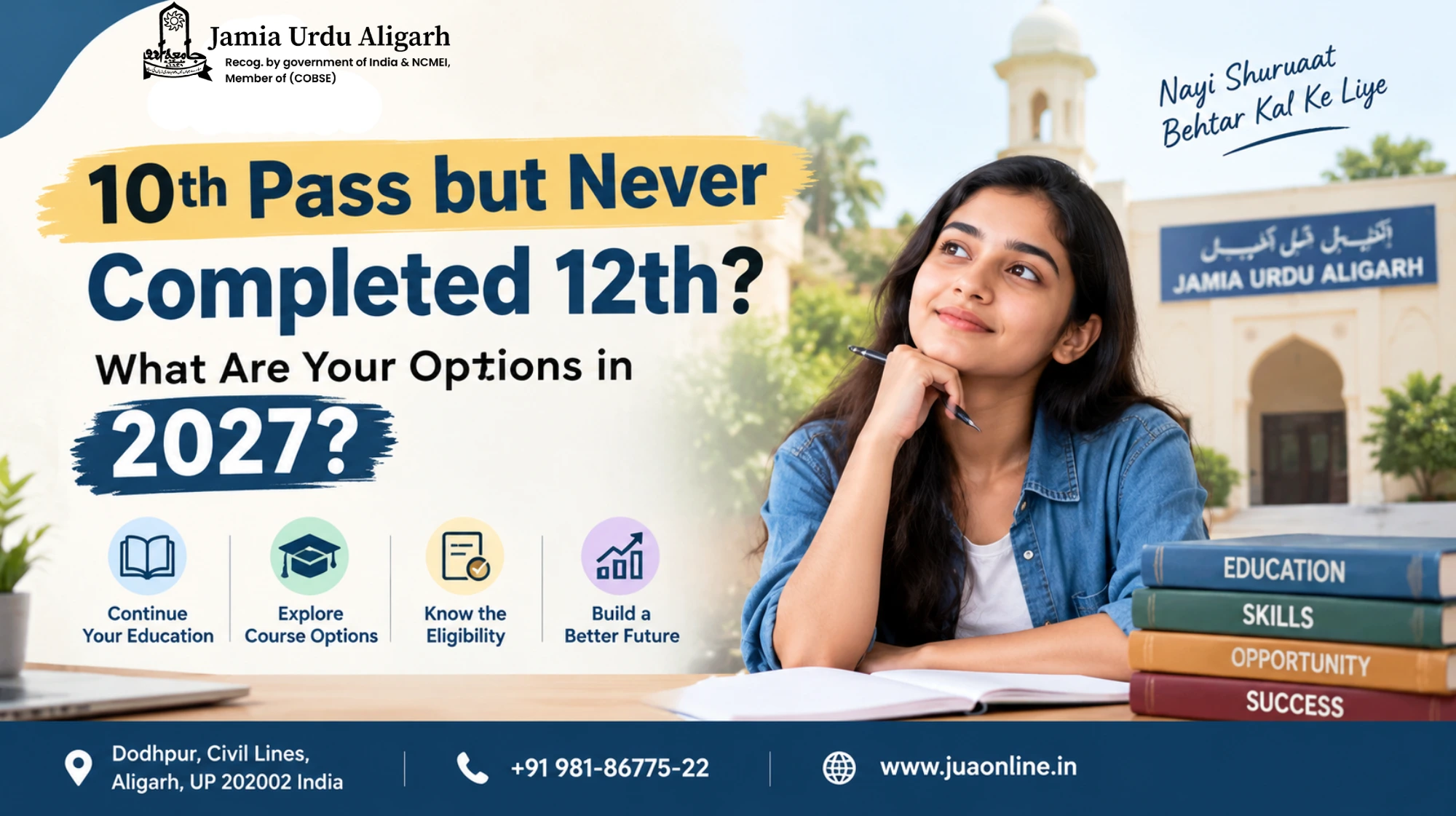
If you have passed Class 10 but never completed Class 12, there are still options to continue your education in 2027. Students may explore suitable education programmes based on their previous qualifications, eligibility criteria, and personal circumstances. This guide explains important factors to consider before choosing a study path, including admission requirements, necessary documents, course options, and how to restart your studies after a long gap. Always verify the recognition and validity of a programme before applying.
Quick Answer
- Finish 12th from home through NIOS (National Institute of Open Schooling) or a State Open School.
- Join a diploma or polytechnic course directly after 10th.
- Join an ITI trade course and get a skill-based job.
- Take a short skill or certificate course and start earning.
- Apply for some government jobs that only need 10th pass.
- Start a small business or freelance work while studying.
The best choice for most people is simple: complete 12th through open schooling and learn a skill at the same time. This keeps every door open for college and jobs.
Voice Search Questions
- " can I do 12th from home after 10th?" Yes, you can do 12th from home through NIOS or a State Open School.
- "What is the best option after 10th if I left 12th?" The best option is to complete 12th through NIOS and learn a skill.
- "Is NIOS 12th valid?" Yes, NIOS 12th is recognised for higher studies and many jobs, as per official rules.
- "Can I get a job after 10th pass?" Yes, you can apply for MTS, Postal GDS, some Railway posts and private jobs.
- "How long does NIOS 12th take?" Usually 1 to 2 years, depending on how many subjects you clear at a time.
Table of Contents
- Why Many Students Leave 12th (And Why It Is Okay)
- Your 7 Main Options After 10th in 2026–27
- Option 1: Complete 12th from Home with NIOS
- Option 2: State Open Schools
- Option 3: Diploma and Polytechnic Courses
- Option 4: ITI Courses
- Option 5: Skill and Certificate Courses
- Option 6: Government Jobs for 10th Pass
- Option 7: Private Jobs, Freelancing and Business
- Can You Do 12th from Jamia, AMU or Urdu University?
- Step-by-Step Plan to Complete 12th from Home
- Documents You Need
- Common Mistakes to Avoid
- Comparison Table
- 10 FAQs with Answers
- Final Words
Why Many Students Leave 12th (And Why It Is Okay)
Every year, lakhs of students in India pass Class 10 and then stop studying. The reasons are very common:
- Family money problems
- Need to start working early
- Marriage or family duties, especially for girls
- Failing in one or two subjects and losing hope
- Health problems
- Moving to a new city or state
- No good school nearby
- Losing interest in regular school
If this is your story, please do not feel shy or small. Education has no expiry date in India. The system today is very flexible. You can study from home, give exams when you are ready, and even change subjects.
The real question is not "What did I miss?" The real question is "What is my best next step in 2027?" This guide answers that, in simple words.
Your 7 Main Options After 10th in 2026–27
No. | Option | Best For | Time Needed |
|---|---|---|---|
1 | NIOS Senior Secondary (12th) | Anyone who wants a 12th certificate from home | 1–2 years |
2 | State Open School | Students who want 12th in their state language | 1–2 years |
3 | Diploma / Polytechnic | Students who want engineering or technical jobs | 3 years |
4 | ITI Trade Course | Students who want a quick technical job | 1–2 years |
5 | Skill / Certificate Course | Students who want to earn fast | 3–12 months |
6 | Government Job (10th Pass) | Students who want a stable job | Varies |
7 | Private Job / Freelance / Business | Students who need income now | Immediate |
Now let us understand each one properly.
Option 1: Complete 12th from Home with NIOS
What is NIOS?
NIOS stands for National Institute of Open Schooling. It is run under the Ministry of Education, Government of India. It is one of the biggest open schools in the world. NIOS gives a Senior Secondary (Class 12) certificate that is recognised across India for higher studies and many jobs.
Why NIOS is the best option for most people
- Study from home. You do not need to go to school every day.
- Flexible exams. NIOS usually holds public exams twice a year (around April–May and October–November). It also offers on-demand exams in many subjects.
- Choose your subjects. You can pick subjects that suit you. This is a big help for students who failed in a subject earlier.
- Multiple languages. Study material is available in Hindi, English, Urdu and some other languages.
- Credit transfer. If you already passed some subjects before, you may be able to transfer credits. Check the official rules.
- Recognised certificate. NIOS 12th is treated as equal to other boards for admission, as per official rules, but always check the college rules once.
Basic eligibility (check the official site before applying)
- You must have passed Class 10 from a recognised board (CBSE, ICSE, State Board or NIOS).
- There is a minimum age rule. Generally the student should be around 15 years or above for senior secondary. Please confirm the exact rule on the official NIOS website for your session.
- There is usually no upper age limit.
How many subjects do you need?
Usually you need to pass five subjects, including two languages. Your options normally include:
- Languages: Hindi, English, Urdu and others
- Streams: Science, Commerce, Humanities
- Vocational and skill subjects
Important points to remember
- NIOS is not easier in marks, but it is easier in flexibility.
- Your study centre is called an AI (Accredited Institution). Choose a trusted one near you.
- Download study material from the official site. Keep notes in simple language.
- Practise with sample papers.
Official website tip: Always apply only through the official NIOS website. Avoid agents who promise "100% pass" or "without exam". There is no such thing.
Option 2: State Open Schools
Many states have their own open schooling boards. For example, Delhi Board of Open Schooling (DBOS) is in Delhi. Other states also run similar boards, such as state open schools in Maharashtra, Gujarat, Telangana, Andhra Pradesh and more.
Why choose a State Open School?
- Study material is often available in your local language.
- Admission rules can be simple for local students.
- Fees are often low.
- Good if you want to stay close to your home state.
Things to check
- Is the certificate valid for your future plans?
- Is it accepted by colleges outside your state?
- What is the last date of admission?
Simple rule: If you plan to move to other states for college or jobs, NIOS is usually the safer and wider choice.
Option 3: Diploma and Polytechnic Courses
If you do not want to waste time, a diploma after 10th is one of the best choices. It is a 3-year technical course. After this you can:
- Get a job as a junior engineer or technician
- Join the second year of B.Tech/B.E. through lateral entry (rules vary by state and college)
- Prepare for government exams
Popular diploma branches
- Civil Engineering
- Mechanical Engineering
- Electrical Engineering
- Computer Engineering / IT
- Electronics
- Automobile
- Fashion Design
- Pharmacy (usually needs 12th, so check)
How to apply
Most states hold a centralised counselling for polytechnic admission. Check your state technical education board website for dates, usually in May to July.
Option 4: ITI Courses
ITI means Industrial Training Institute. These are short, job-focused courses after Class 8 or 10, depending on the trade.
Popular ITI trades
- Electrician
- Fitter
- Welder
- Mechanic (Motor Vehicle)
- COPA (Computer Operator and Programming Assistant)
- Plumber
- Refrigeration and AC Mechanic
Benefits
- Duration is 1 to 2 years.
- Low fees, especially in government ITIs.
- Strong demand in factories, railways, construction and private companies.
- Apprenticeship options help you earn while you learn.
Pro tip
You can do ITI and complete 12th through NIOS at the same time. Many students do this. It gives you both a skill and a certificate.
Option 5: Skill and Certificate Courses
In 2026, skills matter as much as degrees in many fields. Short courses can help you start earning in 3 to 12 months.
High-demand skills
- Digital Marketing (social media, SEO, ads)
- Basic Computer and Tally
- Graphic Design and video editing
- Mobile repairing
- Beauty and wellness
- Stitching, tailoring, fashion
- Electrician and solar panel installation
- Data entry and office work
- Spoken English
- Driving (LMV) with licence
Where to learn
- Government schemes like Skill India / PMKVY centres (check for current availability)
- Local training institutes
- Free and low-cost online platforms
Tip: Choose courses that give a certificate and practical training, not only videos.
Option 6: Government Jobs for 10th Pass
Yes, there are real government jobs where 10th pass is enough. Vacancies and rules change every year, so always read the latest notification.
Common jobs
- MTS (Multi-Tasking Staff) under SSC
- Railway Group D / Level 1 posts (some posts need ITI or 10th)
- Police Constable (some states allow 10th; many ask 12th, so check)
- Postal services: Gramin Dak Sevak (GDS) posts
- Defence roles such as some Agniveer categories
- Anganwadi worker/helper (state-wise rules)
- Peon / attendant / driver posts in departments
Honest advice
Competition is high. Many good posts need 12th pass. If you complete 12th, your list of eligible jobs becomes much bigger, including SSC CHSL, many police posts and more.
Option 7: Private Jobs, Freelancing and Starting a Business
If you must earn now, you can:
- Work in retail, delivery, logistics or hospitality
- Take a job in a small office or shop
- Start freelancing (typing, translation, design, social media posts)
- Open a small business such as a mobile shop, tailoring, tuition, or an online store
Smart plan: Work during the day and study for 12th at night or on weekends through open schooling. Many people have built their careers this way.
Can You Do 12th from Jamia, AMU or an Urdu University from Home?
This is a very common question, so here is a clear and honest answer.
Jamia Millia Islamia (JMI), Delhi
- Jamia has its own Senior Secondary School, but it is mainly a regular school. Admission is limited and follows Jamia's own rules.
- For students who want to study from home, Jamia is usually used after 12th, for example through its distance and open learning programs for graduation.
- So if you want to complete 12th from home, NIOS or a State Open School is the practical path.
Aligarh Muslim University (AMU), Aligarh
- AMU runs well-known senior secondary schools on campus. These are regular, in-person schools.
- AMU's distance and online education programs are mainly for graduation and above.
- So AMU is a great choice after 12th, not as a home-based 12th option.
Maulana Azad National Urdu University (MANUU), Hyderabad
- MANUU is famous for Urdu-medium higher education through distance mode.
- It mainly offers programs for graduation, post-graduation, diploma and certificate courses.
- It is very helpful for Urdu-medium students after 12th.
Best plan for Urdu-medium students
- Complete 12th through NIOS in the Urdu medium (NIOS offers study material and exams in Urdu for many subjects).
- After 12th, apply for BA, B.Com or other courses through Jamia (CDOL), AMU, MANUU or IGNOU.
- Keep checking the latest rules, as seats, courses and eligibility change every year.
Important note: University programs, fees and eligibility change. Always confirm from the official website or helpline of each university before applying.
After 12th from Home: What Can You Do Next?
Once you complete 12th through NIOS or any open school, you can:
- Do graduation (BA, B.Com, B.Sc, BBA, BCA) from regular or distance universities like IGNOU, Jamia, AMU, MANUU and state open universities
- Apply for CUET for many central universities
- Prepare for competitive exams like SSC CHSL, Railway, Banking, Police, Teaching, and more
- Join professional courses like D.El.Ed, nursing, pharmacy, ITI-to-degree paths (rules vary)
- Start a better job or business with confidence
Step-by-Step Plan to Complete 12th from Home in 2026–27
Step 1: Decide your goal
Ask yourself: Do I want a government job, a college degree, or a skill-based job?
Step 2: Choose your board
- Want all-India validity? Choose NIOS.
- Want your state language and local support? Check your State Open School.
Step 3: Check eligibility
Make sure you have your Class 10 pass certificate and marksheet.
Step 4: Pick your subjects
- Humanities is usually easiest to manage for working students.
- Commerce suits students who want to do B.Com or business later.
- Science is possible, but practicals may need extra effort and time.
Step 5: Register online
Visit the official website, fill in the form, upload documents and pay the fee. Keep your receipt safe.
Step 6: Get study material
Download from the website or collect from your study centre.
Step 7: Make a simple study plan
- Study 2 to 3 hours daily
- Finish one chapter at a time
- Revise every Sunday
- Solve previous year papers
Step 8: Fill the exam form on time
Do not miss dates. Late fees can apply.
Step 9: Give your exams
You can often choose when to appear in the exam, depending on the schedule and rules.
Step 10: Download your result and certificate
Save digital copies. Use DigiLocker if available.
Documents You Usually Need
- Class 10 marksheet and pass certificate
- Aadhaar card or other ID proof
- Passport-size photographs
- Signature scan
- Category certificate (if applicable)
- Mobile number and email ID
- Bank details for payment and scholarships (if any)
Common Mistakes to Avoid
- Trusting agents who promise "without exam" 12th. These are often fake and your certificate may not be valid.
- Not checking the official website. Always confirm dates and fees.
- Choosing too many difficult subjects at once.
- Delaying the decision. Every year of delay makes it harder.
- Studying without a plan.
- Ignoring English and basic computer skills.
- Believing that open school certificates have no value. They are valid when you take them from recognised boards.
- Skipping practicals and project work if your subject needs them.
Which Option Is Best for You? Simple Guide
Your Situation | Best Choice |
|---|---|
I want college and a degree later | NIOS 12th, then graduation |
I want a technical job fast | ITI or Diploma |
I need money now | Job plus NIOS study at night |
I want a government job | NIOS 12th plus exam preparation |
I am a homemaker or married woman | NIOS from home plus skill course |
I speak Urdu mostly | NIOS in Urdu medium, then Jamia/AMU/MANUU for graduation |
I failed in some subjects earlier | Open school with subject choice and credit transfer (check rules) |
10 Frequently Asked Questions
1. I passed 10th but never completed 12th. What can I do in 2027?
You have many choices. You can complete 12th through NIOS or a State Open School, join a diploma or ITI, take a skill course, or apply for jobs that need only 10th pass. The smartest path is usually to finish 12th through open schooling while learning a skill or working. This keeps your future options wide open.
2. Can I do 12th from home after 10th?
Yes. You can do 12th from home through NIOS or your State Open School. You study using books or online material and give exams at an exam centre. You do not need to attend school daily. Always apply only through the official website.
3. Is NIOS 12th valid for government jobs and colleges?
Yes, NIOS Senior Secondary is a recognised certificate and is widely accepted for college admission and many government exams, as per the official rules. Still, some courses or jobs may have special conditions. Always read the eligibility section of the exact notification or college prospectus before applying.
4. Can I do 12th from Jamia Millia Islamia from home?
Jamia's own senior secondary school is mainly a regular, in-person school. For home-based 12th, most students use NIOS or a State Open School. Jamia is a great choice after 12th, especially for graduation through its distance and open learning options. Please check Jamia's official website for current admission rules.
5. Can I do 12th from AMU (Aligarh Muslim University) from home?
AMU's senior secondary schools are regular campus schools. AMU's distance and online programs are generally for graduation and above. So for 12th at home, choose NIOS, then consider AMU for higher studies after 12th, subject to current rules.
6. I study in Urdu medium. Which option is best for me?
You can take NIOS 12th with Urdu medium support in many subjects. After that, you can apply for graduation through MANUU, Jamia, AMU or IGNOU. MANUU is especially strong for Urdu-medium distance education. Always confirm the available courses and mediums in the latest session.
7. How long does it take to complete 12th from home?
Most students take 1 to 2 years. Because NIOS allows flexible exam timing and lets you attempt subjects in different sessions, you can plan your pace. Students who study regularly may finish faster. Rules can allow several years in total, so check the official limit.
8. Can I get a government job with only 10th pass?
Yes, some jobs such as MTS, Gramin Dak Sevak, certain Railway Group D posts and some defence roles accept 10th pass candidates. But competition is high, and many better posts need 12th pass. Completing 12th increases your chances a lot.
9. What is better after 10th: ITI, Diploma or 12th?
It depends on your goal. ITI is best for a quick technical job. Diploma is best for engineering-type careers and can lead to lateral entry in B.Tech. 12th is best if you want college degrees, a wider range of government jobs, and more freedom. Many people combine ITI or a skill course with NIOS 12th.
10. Can I study 12th at home and work at the same time?
Yes. This is one of the biggest benefits of open schooling. You can work during the day and study in your free hours. Make a weekly plan, study 2 to 3 hours daily, and use the sample papers. Many working adults, homemakers and married women complete 12th this way every year.
Final Words
If you passed 10th but never completed 12th, you are not late, and you are not behind. India offers flexible and recognised ways to complete 12th from home, learn a skill, and build a better future. Do not wait for the "perfect time". Take one small step today:
- Visit the official NIOS or State Open School website
- Check eligibility and dates
- Choose your subjects
- Register and start your first chapter
One year from now, you will thank yourself for starting today. Your 12th certificate can open the door to graduation, government jobs, and a more confident life.
Quick Summary
- Problem: Passed 10th, did not finish 12th.
- Best solution: Complete 12th through NIOS or a State Open School from home.
- Other options: Diploma, ITI, skill courses, 10th-pass government jobs, private work.
- For Urdu-medium students: NIOS in Urdu, then graduation via Jamia, AMU, MANUU or IGNOU.
- Time needed: About 1 to 2 years for 12th.
- Key tip: Always use official websites and avoid "without exam" agents.
Disclaimer: Admission rules, fees, dates and eligibility change every year. Please confirm all details on the official websites of NIOS, State Open Schools, universities and government departments before applying.
PART 2: THE DEEP-DIVE GUIDE (Everything You Still Need to Know)
This part goes deeper into every option. Read it slowly, take notes, and use it as your personal roadmap for 2026–27.
Deep Dive: How NIOS Senior Secondary Really Works
Many people hear "NIOS" but do not know how it actually works day to day. Here is the full picture in simple words.
1. The structure of your 12th at NIOS
A NIOS Senior Secondary course is built from subjects. Each subject has:
- Theory paper (the main written exam)
- Practical or project work (in subjects like Science, Home Science, Computer and some others)
- Tutor Marked Assignments (TMA) (small written assignments checked by a tutor, in many subjects)
To pass a subject you generally need to score the minimum pass marks (commonly 33%) in theory and also in practical where it applies. Please confirm the exact marking scheme on the official NIOS website because rules can be updated.
2. How to choose your five subjects
A smart subject combination can save you a lot of stress. Use this simple method:
- Pick two languages first. Most students choose English plus Hindi or Urdu. Choose the language you can already read and write well.
- Pick two or three subjects linked to your goal. For example, Accountancy and Business Studies for Commerce, or History and Political Science for Humanities.
- Add one easy or skill-based subject. This can be Data Entry, Home Science or another vocational subject. It gives you a practical skill and extra marks.
3. Sample subject combinations
Your Goal | Possible Subject Combination |
|---|---|
BA, teaching, government jobs | Hindi/Urdu, English, History, Political Science, Economics |
B.Com, banking, accounts | English, Hindi/Urdu, Accountancy, Business Studies, Economics |
BCA, computer jobs | English, Hindi/Urdu, Maths, Computer Science, Economics |
Home-based skill and degree | English, Hindi/Urdu, Home Science, Psychology, Data Entry |
Medical or science path | English, Physics, Chemistry, Biology (needs practicals, plan carefully) |
These are only examples. Always check the official list of subjects and the rules on subject combinations before you register.
4. Exam options at NIOS
- Public exams: Usually held twice every year, in the April–May window and the October–November window.
- On-Demand Examination (ODE): Available for some subjects, so you can appear when you feel ready. This is excellent for working students and homemakers.
- Exam centres: You usually get a centre in or near your city. Admit cards are downloaded online.
5. Time limit and attempts
NIOS gives you a long period and many attempts to finish your Senior Secondary course. This means you can pass some subjects first and clear the rest later. Check the official rule for your current admission year to know the exact number of years and attempts.
6. Credit transfer for students who already passed some subjects
If you have earlier passed some subjects in Class 11 or Class 12 from another board, you may be able to ask for credit transfer for those subjects. This can reduce your workload. Apply with your old marksheets and check the official rules and fees.
7. Fees
Fees depend on the number of subjects, your category, gender and whether you apply with or without late fee. Fees change by session, so check the official site for the exact amount instead of trusting random blogs or agents. Some categories get fee concessions as per official rules.
8. Study material
NIOS provides books (printed or PDF), audio and video lessons, and an online learning platform. You can also use e-books, recorded lectures and sample papers from the official portal. Study material is usually available in English and Hindi, and in Urdu for many subjects.
9. Personal contact programmes (PCP)
Some study centres hold classes on weekends or holidays. These are called PCP classes. They are optional but very helpful if you are weak in a subject or need help from a teacher.
Deep Dive: A 12-Month Study Plan for Working Students and Homemakers
Most people who leave school are busy with work or home duties. This plan is made for you.
Month 1–2: Foundation
- Register and collect all study material.
- Read each subject's syllabus once.
- Make a weekly timetable.
- Start with the easiest subject to build confidence.
Month 3–5: Learn Chapter by Chapter
- Study one chapter in 2–3 days.
- Write short notes in your own words.
- Do the in-text and intext questions at the end of every lesson.
- Submit TMAs on time.
Month 6–7: First Revision
- Revise all notes once.
- Solve at least two years of previous papers for every subject.
- Mark weak topics in red and study them again.
Month 8–9: Practice and Mock Tests
- Solve full-length sample papers in the same time as the real exam (usually 3 hours).
- Practise writing neat answers with headings and points.
- Join a study group, in person or on WhatsApp, to discuss doubts.
Month 10: Final Revision and Practicals
- Revise formulae, dates, definitions and diagrams.
- Complete your practical files and project work.
- Check your admit card, exam centre and date.
Month 11–12: Exam and Result
- Give your exams with a calm mind.
- Do not discuss the paper after the exam. Prepare for the next one.
- Download your result and apply for your next step.
Daily routine that works
Time | Activity |
|---|---|
1 hour (morning) | Read one new topic |
1 hour (evening) | Write notes and answer questions |
30 minutes (night) | Quick revision of the day |
Sunday | Weekly revision and a mini test |
Even 2 hours a day is enough if you are consistent.
Deep Dive: Subject-Wise Tips (Easy to Follow)
English
- Read a short English news article every day.
- Learn 5 new words daily and use them in sentences.
- Practise writing letters, notices and short essays.
Hindi / Urdu
- Read the lessons aloud.
- Practise grammar, letter writing and essay topics.
- For Urdu, practise your handwriting and spelling because clean answers help in scoring.
Maths
- Practise daily, not just on weekends.
- Learn formulae on a single sheet and revise it every morning.
- Solve examples first, then exercises.
Accountancy
- Practise journal entries, ledgers and balance sheets again and again.
- Make a list of common mistakes and avoid them.
Business Studies and Economics
- Learn definitions and examples.
- Use diagrams and short real-life examples to explain your answers.
History, Political Science and Geography
- Make timelines and mind maps.
- Learn maps and important dates.
- Write answers in short points with headings.
Science (Physics, Chemistry, Biology)
- Understand concepts, not just formulae.
- Keep a diagram notebook.
- Do not skip practicals.
Computer Science / Data Entry
- Practise on a real computer or a mobile app.
- Learn typing for 15 minutes daily.
Deep Dive: Special Guidance for Girls, Women and Homemakers
Many girls leave studies due to marriage, family duties or safety reasons. If this is you, here is the good news: open schooling was built for people exactly like you.
- You can study at home, at your own speed.
- You do not need to attend regular classes.
- Exams are given at a centre, usually in your city.
- You can combine 12th with a home-based skill like tailoring, beauty, cooking, tuition, or digital work.
- After 12th, you can study further through distance universities, including IGNOU, Jamia, AMU and MANUU, and many state open universities.
Tips for you
- Fix a quiet time slot, even 90 minutes in the afternoon.
- Talk to your family about your plan. Ask them to share household time.
- Join a women's study group or online community.
- Keep your documents safe.
- Check for scholarships and fee concessions for girls and women in your state and category.
Deep Dive: Special Guidance for Students Who Failed Earlier
If you failed Class 11 or 12 once or twice, you are not alone, and it does not mean you are weak.
Common reasons students fail:
- Weak basics in one subject, usually Maths, English or Science
- Poor time management
- Lack of guidance
- Family or health problems
- Exam fear
What to do now
- Identify the real reason you failed.
- Choose subjects that fit your strengths. Open school gives you that freedom.
- Start with the subject you like most.
- Take help. Use online lectures, a friend or a tutor for tough topics.
- Give one exam at a time if needed. You do not have to clear everything together.
A second chance is also a better chance, because now you understand what went wrong.
Deep Dive: 12th Through Open School vs Regular School
Point | Open School (NIOS / State Open) | Regular School |
|---|---|---|
Attendance | Not compulsory | Compulsory |
Flexibility | Very high | Low |
Subject choice | Wide choice | Limited by school |
Exam timing | Flexible, often more than one chance a year | Once a year |
Cost | Usually lower | Usually higher |
Best for | Working students, homemakers, dropouts | Full-time students |
Certificate | Recognised (check each college's rules) | Recognised |
Discipline needed | Self-discipline is a must | School provides structure |
The main thing to remember: open school gives freedom, but you must bring your own discipline.
Deep Dive: Diploma After 10th in More Detail
Who should choose a diploma?
- You like practical, technical and hands-on work.
- You want to start earning earlier.
- You are okay with a 3-year course.
Benefits
- Good for jobs in factories, power plants, construction, IT support, and service sectors.
- You can take lateral entry into the second year of B.Tech or B.E. in many states.
- Many government departments hire diploma holders as junior engineers or technical assistants.
Things to check before taking admission
- Is the college approved by AICTE or the state board? Always verify on the official website.
- Is the diploma recognised by the state technical board?
- What are the placement records?
- What is the total fee?
Can you do diploma and 12th together?
It is normally not recommended because both are heavy. But ITI plus NIOS 12th is a commonly followed combination because ITI is less theory-heavy.
Deep Dive: ITI After 10th in More Detail
Types of ITI trades
- Engineering trades: Electrician, Fitter, Welder, Turner, Machinist, Mechanic, Draughtsman
- Non-engineering trades: COPA, Stenography, Dress Making, Beauty and Wellness, Fashion Design
Duration
Different trades have different durations, usually between 6 months and 2 years.
Career after ITI
- Private jobs in factories and workshops
- Apprenticeship under the Apprentices Act, where you earn a stipend while learning
- Government jobs in railways, power, and defence (check latest notifications)
- Self-employment such as an electrician's shop, a garage, or a repair centre
- After ITI, you may also move to higher technical courses in some states under bridge or lateral entry options
Government ITI vs Private ITI
Point | Government ITI | Private ITI |
|---|---|---|
Fees | Low | Higher |
Seats | Limited | More |
Admission | Merit or counselling | Direct or merit |
Recognition | Government approved | Check NCVT/SCVT approval |
Always choose an ITI that is NCVT or SCVT affiliated. Otherwise, the certificate may not be valid.
Deep Dive: Skill Courses That Can Help You Earn Faster in 2026
1. Digital Marketing
Businesses today need people who can manage social media pages, run ads, and write content. You can learn this in 3 to 6 months. You can freelance, work in an agency or manage your own page.
2. Graphic Design and Video Editing
Designers and editors are always in demand for social media content, YouTube and local businesses.
3. Accounting and Tally
Small shops and offices need people who can maintain accounts and do GST entries. This is an easy skill if you like numbers.
4. Mobile and Laptop Repair
A practical skill that can become your own shop.
5. Electrician, Solar and AC Repair
Rising demand because of new homes and solar systems.
6. Beauty, Wellness and Fashion
Good for girls and women who want a home-based or salon business.
7. Spoken English and Communication
This helps in every job. Better English can lead to better salary and confidence.
8. Data Entry and Basic Excel
A simple office skill that is useful for many entry-level jobs.
9. Driving and Logistics
Driving with a valid licence can lead to jobs in delivery, taxi services and transport companies.
10. Teaching and Tuition
If you are good at a subject, you can start teaching younger children while studying.
Smart tip: Choose one skill and master it rather than learning five things halfway.
Deep Dive: Government Jobs After 10th vs After 12th
This is the biggest reason to complete 12th. Look at the difference.
Exam / Job Type | 10th Pass Enough? | 12th Pass Needed? |
|---|---|---|
SSC MTS | Yes | No |
Railway Group D | Yes (many posts) | No |
Postal GDS | Yes | No |
SSC CHSL (Clerk, Data Entry Operator) | No | Yes |
Many State Police Constable posts | Varies by state | Often yes |
Teaching entry (primary level, D.El.Ed etc.) | No | Yes |
Banking clerk exams | No | Graduation needed |
NDA (Defence academy) | No | Yes |
Posts and rules change in every notification. Always read the latest official advertisement before applying.
The simple truth
With 10th pass, you can apply for entry-level jobs. With 12th pass, you can apply for clerical, technical and many higher-level jobs. With graduation, you can apply for officer-level and banking jobs. So 12th is not just a certificate. It is the key to the next level.
Deep Dive: Studying Further After 12th Through Distance Mode
Once you finish 12th, you do not have to stop. Many universities offer degrees through distance and open learning, which means you can study from home.
Popular options
University | What It Is Known For |
|---|---|
IGNOU | One of the largest open universities in the world, with many UG and PG courses |
Jamia Millia Islamia (Distance and Open Learning) | Selected UG and PG programs, check the current list |
Aligarh Muslim University (Distance and Online Education) | Selected UG and PG programs, check the current list |
Maulana Azad National Urdu University (MANUU) | Urdu-medium and English-medium distance programs, certificates and diplomas |
State Open Universities | Local-language degrees in many states |
Programs, eligibility, fees and admission dates change. Please confirm everything on the official website.
Popular courses after 12th
- BA (Hindi, Urdu, English, History, Political Science and more)
- B.Com
- BBA / BCA (check which universities offer them in distance mode)
- B.Ed (usually needs graduation first)
- D.El.Ed or similar teacher training (rules vary by state)
- Diploma and certificate courses in computer, journalism, library science, and more
Deep Dive: Urdu-Medium and Muslim Community Students
This section is written especially for students who read and write in Urdu and often ask about Jamia, AMU and MANUU.
What you should know
- NIOS offers Urdu as a language subject and Urdu-medium study material and exams in many subjects. This makes NIOS very friendly for Urdu-speaking students.
- Jamia and AMU are best seen as your "next step" after 12th, not as a replacement for open schooling at the 12th level.
- MANUU is made for Urdu-medium higher education and is a smart choice after 12th.
- Madrasa students who completed 10th-equivalent or higher studies should check the official recognition rules. Some madrasa certificates are treated as equal to Class 10 or 12 by certain universities under specific conditions. Always confirm with the university you want to join.
A simple roadmap for an Urdu-medium student
Stage | What to Do |
|---|---|
After 10th | Register for NIOS Senior Secondary with Urdu language and Urdu-medium subjects where available |
During 12th | Study 2 hours daily, practise Urdu and English writing |
After 12th | Apply for BA/B.Com via MANUU, Jamia, AMU, IGNOU or a regular college |
After graduation | Prepare for teaching, civil services, banking, journalism, translation or higher studies |
Careers where Urdu skill gives you an advantage
- Teaching (Urdu teacher posts in schools)
- Translation and interpretation
- Journalism and digital media
- Government departments with Urdu translator posts
- Content writing for Urdu audiences
- Legal and court-related work in some regions
How to Spot Fake Websites and Fake "12th Without Exam" Offers
Sadly, many frauds target people who want to finish 12th quickly. Be careful.
Red flags
- "Get 12th certificate in 7 days"
- "No exam, no study, only payment"
- Website does not end in an official domain used by the board
- Asking for large payments through personal bank accounts or UPI
- No physical address or phone number
- Promising a guaranteed job
- Social media ads with fake testimonials
How to stay safe
- Search the board's name and use only the official website.
- Look for the "gov.in" or the board's official domain.
- Call the official helpline number given on the site.
- Never pay in cash to agents without a receipt.
- After registration, verify your enrolment number on the official portal.
- Keep every receipt and screenshot.
Remember: A fake certificate can destroy your job and your future. There is no shortcut to a real 12th certificate.
Mindset: Why Starting Late Is Not a Problem
Many people feel ashamed to restart studies after a gap. Let us look at the truth.
- Thousands of adults, homemakers and workers complete 12th every year.
- Maturity helps you study better. You now understand why education matters.
- Employers care more about skill and certificate than about when you finished.
- Every year you wait, the gap becomes bigger. The best time to start is now.
Five habits that help late learners succeed
- Make a small daily promise. Study just one hour, but every day.
- Track your progress. Tick every chapter you finish.
- Reward yourself after every unit.
- Stay away from negative people who say it is too late.
- Find one study partner to keep you on track.
Your 30-Day Action Plan (Start Today)
Days | What to Do |
|---|---|
Day 1–3 | Decide your goal and check your Class 10 documents |
Day 4–7 | Visit the official NIOS or State Open School website and read the prospectus |
Day 8–10 | Choose your five subjects |
Day 11–15 | Register online, pay the fee and save the receipt |
Day 16–20 | Download study material and make a timetable |
Day 21–25 | Start with your easiest subject |
Day 26–30 | Join a study group and begin a second skill course if possible |
After 30 days, you will already be a registered student with a clear plan. That alone puts you ahead of most people who only think about it.
Money Matters: Can You Afford It?
Many people worry about cost. The good news is that open schooling is generally much cheaper than private regular school. To reduce cost:
- Use the free online study material from the official portal.
- Share books and notes with friends.
- Ask about fee concessions for SC, ST, OBC, women, differently abled candidates and others as per official rules.
- Look for state scholarships and schemes. Check your state education and minority welfare department websites.
- Choose fewer subjects at a time if your budget is tight, then clear the rest later.
10 More FAQs (Bonus Questions People Search on Google and Ask Their Voice Assistant)
11. What is the minimum age to take NIOS 12th?
Usually the candidate should be around 15 years or above for Senior Secondary, and there is generally no upper age limit. Rules may change, so always check the current NIOS prospectus.
12. Can I do 12th if I passed 10th many years ago?
Yes. A gap of many years is fine. Open schooling accepts older Class 10 certificates. Keep your original marksheet safe and apply with it.
13. Is open school 12th accepted for CUET and central universities?
In general, open school certificates from recognised boards like NIOS are accepted for admission, but each university can have its own eligibility rules and subject requirements. Check the official CUET and university notifications before you apply.
14. Can I choose Commerce or Arts in NIOS if I had Science in 10th?
Yes. In Class 10, most students study the same general subjects. You can freely choose Humanities, Commerce or Science in 12th, as long as you follow the NIOS subject rules.
15. Can a married woman or homemaker do 12th from home?
Yes, absolutely. Open schooling is one of the best options for married women and homemakers. You can study at your own speed and give exams when you are ready.
16. Can I do a job and 12th together?
Yes. This is very common. Study 2 hours daily and use weekends for revision. Choose subjects wisely and use on-demand exams if available.
17. How many marks do I need to pass NIOS 12th?
Generally you need at least 33% in each subject, in both theory and practical where applicable. Always confirm the official passing rule.
18. Is there any age limit for government jobs after 12th?
Yes. Every job notification has its own age limit and relaxation rules for different categories. Read the official notification carefully.
19. Can I take admission in diploma after 12th from NIOS?
Yes, NIOS 12th is generally accepted for diploma and many professional courses, but some courses may ask for specific subjects like Physics, Chemistry and Maths. Check each course's eligibility.
20. What is the single best step to take today?
Open the official NIOS website, read the admission details, and list the subjects you will choose. Then register. Action beats worry.
Quick Comparison: Which Path Gives What?
Path | Time | Cost | Main Benefit | Main Limit |
|---|---|---|---|---|
NIOS 12th | 1–2 years | Low | Opens college and many govt jobs | Needs self-discipline |
State Open School | 1–2 years | Low | Local language and support | May be limited to your state |
Diploma | 3 years | Medium | Technical jobs and lateral entry | Longer and more demanding |
ITI | 1–2 years | Low | Fast technical job | Limited higher study without bridge options |
Skill course | 3–12 months | Low to medium | Earn quickly | Not a replacement for 12th |
10th-pass job | Immediate | None | Immediate income | Limited growth without 12th |
One-Page Cheat Sheet (Save This)
- If you want college later: NIOS 12th, then BA or B.Com.
- If you want a quick technical job: ITI or Diploma.
- If you need money now: Job plus open school at night.
- If you speak Urdu: NIOS with Urdu medium, then MANUU, Jamia, AMU or IGNOU.
- If you are a homemaker: NIOS plus a home-based skill.
- If you failed earlier: Open school with subjects you like.
- Always: Use official websites, avoid "without exam" offers, keep documents safe.
Final Message
Your past does not decide your future. Passing 10th was a strong start. Finishing 12th is the next brave step, and in 2026–27 you have more options than any earlier generation. Whether you choose NIOS, a State Open School, ITI, a diploma, or a skill course, take one decision today and begin.
Start small. Start today. Stay consistent. One year from now, you will be holding a 12th certificate and have a new set of doors open for you.
Share this guide with a friend, brother, sister or neighbour who also left studies after 10th. You may change someone's life.
