
Higher secondary and senior secondary education are important stages in the Indian education system. Both terms are often used for Classes 11 and 12, but their meaning and usage may vary across education boards. Understanding the difference between higher secondary and senior secondary helps students know about academic levels, subjects, eligibility, certificates, and future study options. This guide explains their key differences in simple language.
Quick Answer: What Is the Difference Between Higher Secondary and Senior Secondary?
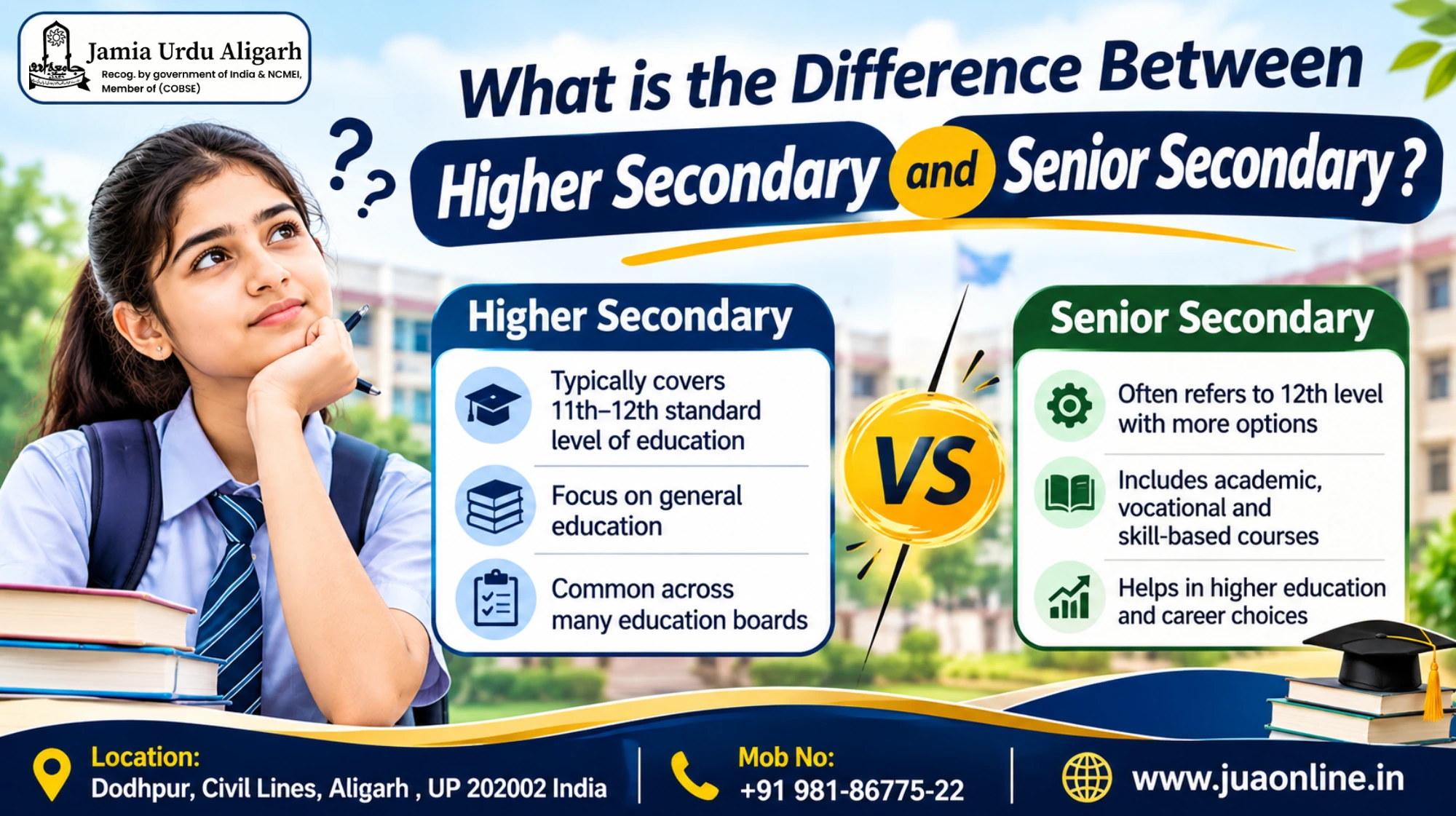
There is no academic difference. Higher Secondary and Senior Secondary both mean Class 11 and Class 12.
The only difference is the name. State boards like Maharashtra, Tamil Nadu, Kerala and West Bengal mostly say "Higher Secondary". National boards like CBSE, CISCE (ISC) and NIOS say "Senior Secondary". The age group (16 to 18 years), the duration (2 years) and the streams (Science, Commerce, Arts) are the same.
So the real question for parents is not "Higher or Senior?" The real question is: "Which board is best for my child?" This guide answers both.
Quick Voice-Search Answers
These short answers are written the way people ask on Google Assistant, Siri and Alexa.
- Q: What is the difference between higher secondary and senior secondary? There is no real difference. Both mean Class 11 and 12. Higher Secondary is mostly used by state boards, and Senior Secondary is mostly used by CBSE, ISC and NIOS.
- Q: Is higher secondary class 11 and 12? Yes. Higher Secondary means Class 11 and Class 12, the last two years of school.
- Q: Is senior secondary the same as 12th class? Senior Secondary means Class 11 and 12 together. Class 12 is the final year of Senior Secondary.
- Q: Is higher secondary the same as 10+2? Yes. The "+2" in 10+2 is Class 11 and 12, which is Higher or Senior Secondary.
- Q: What is the full form of HSC? HSC stands for Higher Secondary Certificate.
- Q: Which board is best for Class 11 and 12? It depends on your goal. CBSE is popular for JEE and NEET, ISC for detailed learning, and state boards for state college quota.
Table of Contents
- Why do people get confused?
- What is Higher Secondary?
- What is Senior Secondary?
- Higher Secondary vs Senior Secondary: comparison table
- Which board uses which name? (Board-wise list)
- Is Higher Secondary the same as 10+2 and Intermediate?
- Streams in Class 11 and 12
- What NEP 2020 means for Class 11 and 12 in 2026
- Step-by-step: how to choose the right board and stream
- What comes after Class 12?
- Quick voice-search answers
- 10 FAQs
- Final thoughts
Why Do People Get Confused Between Higher Secondary and Senior Secondary?
After Class 10, you hear many new words: Higher Secondary, Senior Secondary, HSC, Intermediate, 10+2, PUC, Plus Two. They all sound different, so many parents think they are different levels of education.
They are not. India has many boards, and each board picked its own name for the same two years. Think of it like "lift" and "elevator": two words, one thing.
Here is where Class 11 and 12 sit in the school journey:
Stage | Classes | Age |
|---|---|---|
Foundational | Nursery to Class 2 | 3 to 8 years |
Preparatory | Class 3 to 5 | 8 to 11 years |
Middle | Class 6 to 8 | 11 to 14 years |
Secondary | Class 9 to 10 | 14 to 16 years |
Higher / Senior Secondary | Class 11 to 12 | 16 to 18 years |
This is the stage where students pick a stream, give their final school board exam, and prepare for college entrance tests such as JEE, NEET and CUET.
What Is Higher Secondary?
Higher Secondary means the two-year stage after Class 10, which is Class 11 and Class 12. The word is mostly used by state boards.
Key points:
- Classes covered: 11 and 12
- Who uses this name: Many state boards, such as Maharashtra (HSC), Tamil Nadu, Kerala, West Bengal and Gujarat
- Certificate: Higher Secondary Certificate (HSC) or a similar name given by the state board
- Syllabus: Set by each state, so it can change from state to state
- Exams: Conducted by the state board
- Schools: Called Higher Secondary Schools. In Maharashtra, many students join Junior Colleges for Class 11 and 12
Local names you may hear: Karnataka calls it PUC (Pre-University Course). Andhra Pradesh, Telangana, Bihar and Uttar Pradesh use Intermediate. Kerala also says Plus Two. All of these mean Class 11 and 12.
What Is Senior Secondary?
Senior Secondary also means Class 11 and Class 12. The word is mostly used by national boards.
Key points:
- Classes covered: 11 and 12
- Who uses this name: CBSE, CISCE (ISC) and NIOS. Some state boards, such as Rajasthan and Haryana, also use the word "Senior Secondary" for their Class 12 exam
- Certificate: CBSE Class 12 is officially called the All India Senior School Certificate Examination (AISSCE). CISCE gives the Indian School Certificate (ISC)
- Syllabus: CBSE follows NCERT books and the same syllabus across India
- Exams: Same pattern for students across the country
- Schools: Called Senior Secondary Schools
Because the syllabus is common, a student moving from Delhi to Chennai can usually continue in a CBSE school without a big academic gap.
Higher Secondary vs Senior Secondary: Comparison Table
Point | Higher Secondary | Senior Secondary |
|---|---|---|
Classes | 11 and 12 | 11 and 12 |
Age group | 16 to 18 years | 16 to 18 years |
Duration | 2 years | 2 years |
Mostly used by | State boards | CBSE, CISCE (ISC), NIOS |
Certificate name | HSC or state-specific name | AISSCE (CBSE), ISC (CISCE) |
Syllabus | Different in every state | Same across India (NCERT for CBSE) |
Exam level | State level | National level |
Streams | Science, Commerce, Arts | Science, Commerce, Arts |
JEE / NEET fit | May need extra preparation | Closely based on NCERT, which helps |
State quota advantage | Often yes, for state colleges | Usually no special state quota |
School transfer | Can be hard between states | Easy across India |
Study abroad | Valid, but some countries may ask for an equivalence certificate | Widely known and accepted |
Simple summary: The stage is the same. The board changes the syllabus, exam style, transfer ease and college-quota benefits.
Which Board Uses Which Name? (Board-Wise List)
Board | Common name for Class 11 and 12 | What to know |
|---|---|---|
CBSE | Senior Secondary | NCERT based, strong fit for JEE, NEET and CUET |
CISCE (ISC) | Senior Secondary (ISC) | Detailed and application-based; strong English focus |
NIOS | Senior Secondary | Flexible open school; students can choose subjects and exam time |
Maharashtra (MSBSHSE) | Higher Secondary (HSC) | Strong for MHT-CET and state quota |
Tamil Nadu | Higher Secondary | Class 11 and 12 results matter for state admissions |
Kerala | Higher Secondary / Plus Two | Known for strong science and commerce options |
West Bengal (WBCHSE) | Higher Secondary | Used for state university admissions |
Karnataka | PUC | Pre-University Course; leads to KCET |
Andhra Pradesh, Telangana | Intermediate | Known for strong JEE and NEET coaching culture |
Bihar, Uttar Pradesh | Intermediate | State board Class 11 and 12 |
Rajasthan, Haryana | Senior Secondary | State boards that also use this term |
IB (International Baccalaureate) | IB Diploma Programme | Covers the same age group; global curriculum |
Names and rules can change. Always check your board's latest circular before admission.
Is Higher Secondary the Same as 10+2 and Intermediate?
Yes. All these words describe the same two years:
- 10+2 means 10 years of school, then 2 years of Class 11 and 12
- Higher Secondary means Class 11 and 12 (state board term)
- Senior Secondary means Class 11 and 12 (national board term)
- Intermediate means Class 11 and 12 (used in AP, Telangana, Bihar, UP)
- PUC means Class 11 and 12 in Karnataka
- Plus Two means Class 11 and 12 in Kerala
Colleges treat all valid Class 12 certificates as equal for basic eligibility. Specific courses may have their own entrance rules or cut-offs.
Streams in Class 11 and 12
No matter what the stage is called, students choose subjects in these main groups.
Science
Physics, Chemistry, Maths or Biology, plus Computer Science or Physical Education in many schools. Leads to Engineering, Medicine, Pharmacy, Research, Data Science.
Commerce
Accountancy, Business Studies, Economics, with Maths as an option. Leads to CA, CS, CMA, BBA, B.Com, Finance, Banking.
Arts / Humanities
History, Political Science, Geography, Sociology, Psychology, Economics, Languages. Leads to Law, Civil Services, Journalism, Design, Teaching.
Skill and Vocational Subjects
IT, Retail, Healthcare, Agriculture, Design, Tourism and more. These are now valued more under NEP 2020 and can help students build job-ready skills early.
Tip: Do not choose Science only because it "keeps more options open". Choose the stream where your child is interested and can score well. A motivated Commerce or Arts student can build a great career too.
Read More - 10th Pass but Never Completed 12th? What Are Your Options in 2027?
What NEP 2020 Means for Class 11 and 12 in 2026
The National Education Policy (NEP) 2020 is slowly changing how Class 11 and 12 work. Here are the main ideas in simple words:
- New structure (5+3+3+4): Under NEP, Class 9 to 12 are treated as one four-year Secondary stage. The old words Higher Secondary and Senior Secondary are still used in daily life, boards and schools.
- More subject choice: NEP aims to reduce the hard wall between Science, Commerce and Arts, so students can mix subjects, such as Physics with Economics. How much freedom you get depends on your board and school, so ask the school before admission.
- Skills count: Vocational and skill subjects get more importance.
- Less rote learning: Focus is moving to concepts, problem-solving and real-life use.
- Entrance exams: CUET is used for many central and participating university programmes, which makes Class 12 subject choice more important.
Note: Rollout speed differs between boards and states. Check the official website of your board for the latest rules for 2026–27.
Step-by-Step: How to Choose the Right Board and Stream After Class 10
Follow these 7 simple steps.
Step 1: Understand that the name does not matter
Higher Secondary and Senior Secondary are the same stage. Do not spend time comparing the two words. Compare boards.
Step 2: Write your child's goal
Ask: What does my child want after Class 12? Engineering, medicine, commerce, law, design, study abroad, or sports? Write it down, even if it may change later.
Step 3: Match the goal with an entrance exam
- JEE or NEET goal: CBSE (NCERT based) is often easier to match.
- State engineering or medical seats: Check your state board and state entrance exam rules.
- CUET goal: Check which Class 12 subjects the university wants.
- Study abroad: CBSE, ISC or IB are commonly known worldwide.
Step 4: Check your family situation
- Do you have a transferable job? A national board like CBSE is easier for school change.
- Do you plan to stay in one state? A state board may give a quota benefit in state colleges.
- Is your child studying from home or has an irregular schedule? NIOS or an online school may suit better.
Step 5: Check your child's learning style
- Likes theory and detailed writing: ISC may fit.
- Likes clear, concept-based books: CBSE with NCERT may fit.
- Likes local-language learning: A state board may feel more comfortable.
Step 6: Compare schools, not just boards
A good teacher and a supportive school matter more than the board name. Ask about:
- Subject combinations offered
- Teacher experience
- Doubt-solving support
- Board result history
- Entrance exam guidance
- Fees and total yearly cost
Step 7: Confirm the admission process and documents
Keep these ready:
- Class 10 marksheet
- Transfer Certificate (TC)
- Birth certificate
- Aadhaar or ID proof
- Passport-size photos
- Migration certificate (if you change boards)
Apply early. Seats in popular streams fill fast. If you are changing boards, confirm the last date, subject rules and eligibility on the school and board websites.
Which Is Better: Higher Secondary or Senior Secondary?
Neither is "better" as a stage, because it is the same stage. The board decides the difference.
Choose a Senior Secondary board (CBSE or ISC) if:
- Your child plans for JEE, NEET or CUET
- You may move cities
- You may study abroad
- You want a common syllabus nationwide
Choose a Higher Secondary state board if:
- Your child wants admission in state colleges, where a state quota may apply
- You want a local-language option
- Your child plans for state-level entrance exams
Choose NIOS or an open school if:
- Your child needs flexible timing
- Your child is an athlete, artist, or has a different schedule
Whatever you choose, hard work, a good study plan and regular practice matter most.
What Comes After Class 12?
After Higher or Senior Secondary, students can choose:
Path | Examples |
|---|---|
Degree courses | B.Tech, MBBS, B.Sc, B.Com, BA, BBA, LLB |
Entrance-based admission | JEE, NEET, CUET, CLAT, NID, NATA, state CETs |
Diploma and skill courses | Polytechnic, ITI, NSDC courses |
Professional courses | CA Foundation, CS Foundation |
Study abroad | SAT, ACT, IELTS, TOEFL as required |
Defence and other paths | NDA, Merchant Navy and more |
Detailed Explanation in Simple Words
Let us understand the difference between Higher Secondary and Senior Secondary the easy way, step by step.
Think of it like "Lift" and "Elevator"
In India, some people say "lift" and some say "elevator". The machine is the same. It takes you up and down. Only the word changes.
In the same way, "Higher Secondary" and "Senior Secondary" both take a student through the last two years of school: Class 11 and Class 12. The class level, the age group and the length of study do not change. Only the word used by the board changes.
Why did India end up with two names?
India does not have one single school board. It has a national board (CBSE), a national council (CISCE), an open school (NIOS), and more than 30 state and union territory boards. Each board wrote its own rules and chose its own words long ago.
- Some state boards chose "Higher Secondary" because it is the stage that is higher than Secondary (Class 9 and 10).
- Some national boards chose "Senior Secondary" because it is the senior-most stage in school.
- A few states chose other words, such as Intermediate, PUC or Plus Two.
So the confusion comes from history and naming habits. It does not come from a difference in the level of study.
A real-life example
Example 1: Riya from Delhi. Riya studies in a CBSE school. After Class 10 she joins Class 11. Her school calls itself a Senior Secondary School. At the end of Class 12 she gets a CBSE certificate.
Example 2: Arjun from Pune. Arjun studies under the Maharashtra State Board. After Class 10 he joins Class 11 in a Junior College. At the end of Class 12 he gets the HSC certificate.
Example 3: Meena from Bengaluru. Meena joins PUC after Class 10. After two years she gets her PUC certificate.
All three students are in the same stage of education: Class 11 and 12. They are all aged around 16 to 18. All three can apply to colleges after Class 12, if they meet the rules of the course and the entrance exam.
So what is the real difference?
The stage is the same. What changes is the board. The board decides:
- What you study: the syllabus and the books
- How you are tested: the exam pattern, paper style and marking
- Which entrance exams feel easier: for example, how close the books are to JEE or NEET topics
- How easy it is to change schools: moving between cities or states
- Which admission benefits you may get: such as a state quota in state colleges
One-line summary: Higher Secondary vs Senior Secondary is a question of name. Board A vs Board B is a question of difference.
Simple memory trick for parents
- If a school says "Higher Secondary", think: state board is likely.
- If a school says "Senior Secondary", think: CBSE, ISC or NIOS is likely.
- If a school says "10+2", "Intermediate", "PUC" or "Plus Two", think: same two years, local name.
This rule works most of the time, but not always, because a few state boards also use "Senior Secondary". When in doubt, ask the school: "Which board is this, and what is the exact name of the Class 12 certificate?"
Board-by-Board Deep Dive: Which Board Is Right for Class 11 and 12?
Since the name is only a label, the board is what really matters. Here is a clear explanation of the four most common options.
1. CBSE (Central Board of Secondary Education)
What it is: A national board that follows NCERT textbooks. Its Class 12 exam is called the All India Senior School Certificate Examination (AISSCE).
Pros:
- Same syllabus in every CBSE school across India
- Books are widely used for JEE, NEET and CUET preparation
- Easy to move between cities
- Large number of CBSE schools and coaching support
Cons:
- Competition for top marks can be high
- Some students find NCERT books very theory-heavy without extra practice
Best for: Students planning JEE, NEET, CUET or study abroad, and families who may relocate.
2. CISCE (ISC)
What it is: A national council that conducts the Indian School Certificate (ISC) exam for Class 12. Its Class 10 exam is called ICSE.
Pros:
- Detailed, application-based syllabus
- Strong focus on English and writing skills
- Good for students who enjoy depth in a subject
Cons:
- Syllabus can feel heavy and lengthy
- Fewer schools compared to CBSE or state boards in many towns
Best for: Students who like detailed learning, humanities, and careers that need strong English and analysis.
3. State Boards (Higher Secondary, Intermediate, PUC and more)
What it is: Each state or union territory runs its own board, syllabus and exams.
Pros:
- Often useful for admission to state colleges, where state quota rules may apply
- Local language support
- Usually lower fees in government and aided schools
- Preparation for state entrance exams such as MHT-CET or KCET
Cons:
- Syllabus and marking differ from state to state
- Moving to another state can be harder
- Students may need extra preparation for national entrance exams
Best for: Students who plan to study in their home state and appear for state-level entrance exams.
4. NIOS (National Institute of Open Schooling)
What it is: An open school under the Government of India. Students can choose their subjects and take exams when they feel ready, within the board's rules and exam schedule.
Pros:
- Flexible subject choice and study pace
- Useful for athletes, artists, students with health needs, or those who need flexible timing
- Certificate is recognised for higher education, as per NIOS and institution rules
Cons:
- Needs strong self-discipline
- Some courses or foreign universities may ask for extra proof or equivalence
Best for: Students who need flexibility or a different learning path.
Quick Board Comparison at a Glance
Board | Syllabus type | Best for | Main benefit | Main limit |
|---|---|---|---|---|
CBSE | NCERT based, national | JEE, NEET, CUET, relocation | Common syllabus across India | High competition |
ISC | Detailed, analytical | Humanities, English-strong students | Depth and application | Heavy syllabus |
State Board | State-specific | State colleges and state exams | Possible state quota benefits | Hard to transfer between states |
NIOS | Flexible, open school | Athletes, artists, flexible learners | Choice of subjects and pace | Needs self-discipline |
Important: Always confirm current admission rules, subject combinations and eligibility on the official website of the board and the college or exam you are targeting.
Stream-Wise Guide: Subjects, Skills and Career Paths
Choosing a stream is one of the biggest decisions in Class 11. Here is a deeper look at each option so parents and students can decide with confidence.
Science Stream
Common subjects: Physics, Chemistry, Mathematics and/or Biology, English, plus an optional subject such as Computer Science, Informatics Practices or Physical Education.
Popular combinations:
- PCM (Physics, Chemistry, Maths): for engineering, architecture, data science, defence and research
- PCB (Physics, Chemistry, Biology): for medicine, dentistry, pharmacy, nursing, biotechnology and allied health
- PCMB (all four): for students who want to keep both doors open, though the workload is heavier
Skills needed: logical thinking, problem solving, patience with numbers and concepts, regular practice.
Career options: Engineer, doctor, pharmacist, scientist, pilot, data analyst, software developer, architect, biotechnologist.
Commerce Stream
Common subjects: Accountancy, Business Studies, Economics, English, and Mathematics or another optional subject.
Skills needed: number sense, interest in business and money, clear reasoning, good communication.
Career options: Chartered Accountant (CA), Company Secretary (CS), Cost Accountant (CMA), investment banker, financial analyst, entrepreneur, marketing manager, economist, banker.
Good to know: Taking Mathematics in Commerce can open more options in economics, statistics, data and finance courses.
Arts / Humanities Stream
Common subjects: History, Political Science, Geography, Sociology, Psychology, Economics, languages, and others depending on the board and school.
Skills needed: reading, writing, curiosity about people and society, critical thinking, debate and presentation skills.
Career options: Lawyer, civil servant (IAS, IPS and others), journalist, psychologist, teacher, designer, social worker, content creator, diplomat.
Skill and Vocational Subjects
Many boards now offer skill subjects such as IT, Retail, Healthcare, Tourism, Agriculture, Design and more. These can be taken along with core subjects in many schools. They give students early practical skills and can help in job-oriented paths.
How to Pick: A Simple 3-Question Test
Ask your child these three questions:
- Which subjects do I enjoy even when there is no exam?
- In which subjects do I score well without much stress?
- What kind of work can I see myself doing at age 25?
The stream that matches the answers to all three is usually the best choice.
Stream Summary Table
Stream | Core subjects | Strong fit if you like | Example careers |
|---|---|---|---|
Science (PCM) | Physics, Chemistry, Maths | Problem solving, technology | Engineer, architect, data scientist |
Science (PCB) | Physics, Chemistry, Biology | Life science, helping people | Doctor, pharmacist, biotechnologist |
Commerce | Accountancy, Business Studies, Economics | Business, money, planning | CA, CS, banker, entrepreneur |
Arts / Humanities | History, Political Science, Psychology and more | Reading, writing, society | Lawyer, civil servant, journalist |
Skill / Vocational | IT, Retail, Healthcare and more | Practical, hands-on work | Skill-based and job-ready roles |
Reminder: Subject choices and combinations can differ by board and school, so check what is offered before admission.
Explore More - What is the Pattern of the 10th & 12th Board Exam?
Class 10 to Class 11 Admission Timeline and Mistakes to Avoid
Good planning saves stress. Use this simple timeline as a guide. Exact dates change every year, so always check your school and board notices.
Simple Planning Timeline
- During Class 10 (months before the board exam): Start thinking about stream and board. Talk to teachers, take a free career or aptitude test, and attend school counselling sessions.
- Before Class 10 results: Shortlist 3 to 5 schools. Check board, subjects offered, fees, location, and past results.
- When results are announced: Collect the marksheet. Compare your child's marks with each school's stream eligibility.
- During the admission window: Fill forms, pay the registration fee if required, and attend entrance tests or interviews if the school has them.
- After selection: Confirm the seat, submit documents, and pay fees as per the school's schedule.
- Before Class 11 starts: Buy or download books, set up a study plan, and join bridge classes if your child needs help with weak subjects.
- In the first 3 months of Class 11: Check if the stream feels right. If something is not working, speak to the school counsellor early.
Documents Checklist
- Class 10 marksheet and passing certificate
- Transfer Certificate (TC)
- Birth certificate and age proof
- Aadhaar or other ID proof
- Recent passport-size photographs
- Caste or category certificate, if applicable
- Migration certificate, if you are changing boards
7 Common Mistakes Parents Make (and How to Avoid Them)
- Choosing a stream because of friends or relatives. Every child is different. Pick what fits your child.
- Thinking Science is the only "good" stream. Commerce, Arts and skill streams also lead to excellent careers.
- Confusing the school name with the board. Always ask: "Which board is this school affiliated to?"
- Ignoring entrance exam rules. Check what Class 12 subjects and marks are needed for JEE, NEET, CUET or other exams.
- Waiting too long to apply. Good schools and popular streams fill early.
- Looking only at fees. Compare teacher quality, doubt support, results and total yearly cost.
- Skipping a conversation with the child. Your child will study these subjects for two years. Their interest matters.
7 Common Myths About Higher Secondary and Senior Secondary
Myth 1: Senior Secondary is a higher level than Higher Secondary. Fact: Both are Class 11 and 12. Neither is above the other.
Myth 2: Higher Secondary certificates are not valid outside the state. Fact: A certificate from a recognised board is generally accepted for admission eligibility across India. Colleges may still have their own cut-offs and entrance tests.
Myth 3: Only CBSE students can crack JEE or NEET. Fact: Students from any board can crack these exams. CBSE books are closely linked to the exam syllabus, but state board students who prepare well can also succeed.
Myth 4: Higher Secondary means Class 11 only, and Senior Secondary means Class 12 only. Fact: Each term covers both Class 11 and Class 12.
Myth 5: NEP 2020 has removed Class 11 and 12. Fact: Class 11 and 12 still exist. NEP 2020 changes how the stage is viewed, grouping Class 9 to 12 as one Secondary stage, and gives more flexibility. The change is being rolled out step by step.
Myth 6: Science students always earn more than Commerce or Arts students. Fact: Career success depends on skill, effort, and the right fit. Every stream has strong career paths.
Myth 7: You cannot change your board after Class 10. Fact: Many students change boards at Class 11. Check seat availability, subject rules and documents with the new school.
10 Frequently Asked Questions
1. What is the difference between higher secondary and senior secondary?
There is no difference in class level. Both mean Class 11 and 12. The difference is in the name and the board. State boards generally say Higher Secondary, while CBSE, ISC and NIOS say Senior Secondary. Syllabus, exam style, transfer ease and quota benefits can differ because of the board, not because of the name.
2. Is Class 12 called higher secondary or senior secondary?
Both. Class 12 is the final year of the two-year stage. If your board is a state board, it is usually called Higher Secondary. If it is CBSE, ISC or NIOS, it is usually called Senior Secondary. Some state boards, like Rajasthan and Haryana, also say Senior Secondary.
3. What is the full form of HSC and SSC?
HSC means Higher Secondary Certificate, given after Class 12 by many state boards. SSC usually means Secondary School Certificate, which is the Class 10 certificate in many states such as Maharashtra. CBSE's Class 12 exam is called the All India Senior School Certificate Examination (AISSCE). Always read the full name on the certificate to avoid confusion.
4. Is higher secondary the same as 10+2 and intermediate?
Yes. 10+2 describes the school structure: 10 years of schooling and then 2 years of Class 11 and 12. Intermediate is the local name for Class 11 and 12 in states like Andhra Pradesh, Telangana, Bihar and Uttar Pradesh. Karnataka uses PUC and Kerala often says Plus Two. All point to the same stage.
5. Which is better for JEE and NEET: state board or CBSE?
CBSE is often easier for JEE and NEET because its books follow NCERT, which is the base for these exams. State board students can also crack JEE and NEET, but they may need extra study to cover topics not in their state syllabus. The right preparation, practice tests and a good mentor matter more than the board alone.
6. Is a state board Higher Secondary certificate valid across India?
Yes. A Class 12 certificate from a recognised state board is accepted across India for general admission eligibility. Individual colleges and courses may have their own cut-offs and entrance exams. For some foreign universities, you may need an equivalence certificate, for example from the Association of Indian Universities (AIU). Check with the university before applying.
7. Can my child change from a state board to CBSE after Class 10?
Yes, many students do this. You can take admission in Class 11 in a CBSE-affiliated school if a seat is available in the stream you want. Check the school's eligibility rules, required subjects and the documents needed, such as the Class 10 marksheet and Transfer Certificate. Apply early to avoid seat problems.
8. Which stream is best after Class 10: Science, Commerce or Arts?
There is no single best stream. Science suits students who enjoy Maths, Physics, Chemistry or Biology. Commerce suits students interested in business, accounts and economics. Arts suits students interested in law, history, psychology, media and public service. Choose based on interest, strengths and career goal. Talking to a career counsellor can help you decide.
9. What does NEP 2020 change for Class 11 and 12?
NEP 2020 aims to give students more subject choice, more focus on skills, and less rote learning. It treats Class 9 to 12 as one Secondary stage. The change is happening step by step and is different across boards and states. Ask your school what subject combinations and exam rules apply in 2026–27.
10. How do I choose the right board for Class 11 and 12?
Use this quick rule: decide your child's goal, match it with an entrance exam, think about your family's location and job, check your child's learning style, and compare schools. Then confirm the admission steps and documents. The step-by-step guide above explains each point in detail.
Final Thoughts
Higher Secondary and Senior Secondary are two names for the same stage: Class 11 and Class 12. The name only tells you which type of board a school follows.
What really changes your child's future is the board, the stream, the school and the quality of study support. So do not worry about the words. Focus on the goal.
